



Our Work

Value Based Care

Primary care is the foundation.

Value-Based Care makes it work.

Contribute to this playbook: access our wiki

Help grow our shared knowledge base. Share your team’s templates, insights, and best practices to enrich this collective, open-source playbook.

Value-Based Care

Rebuild primary care.
Improve outcomes.
Lower cost.

Primary Care Is the Foundation

The U.S. will not reach Top Ten health outcomes while spending Ten Percent of GDP unless primary care is rebuilt.

For decades, fee-for-service has paid for visits, procedures, and volume. It has not paid enough for prevention, chronic disease management, care coordination, longer visits, or keeping patients out of the emergency department.

That is the core problem Value-Based Care should solve.

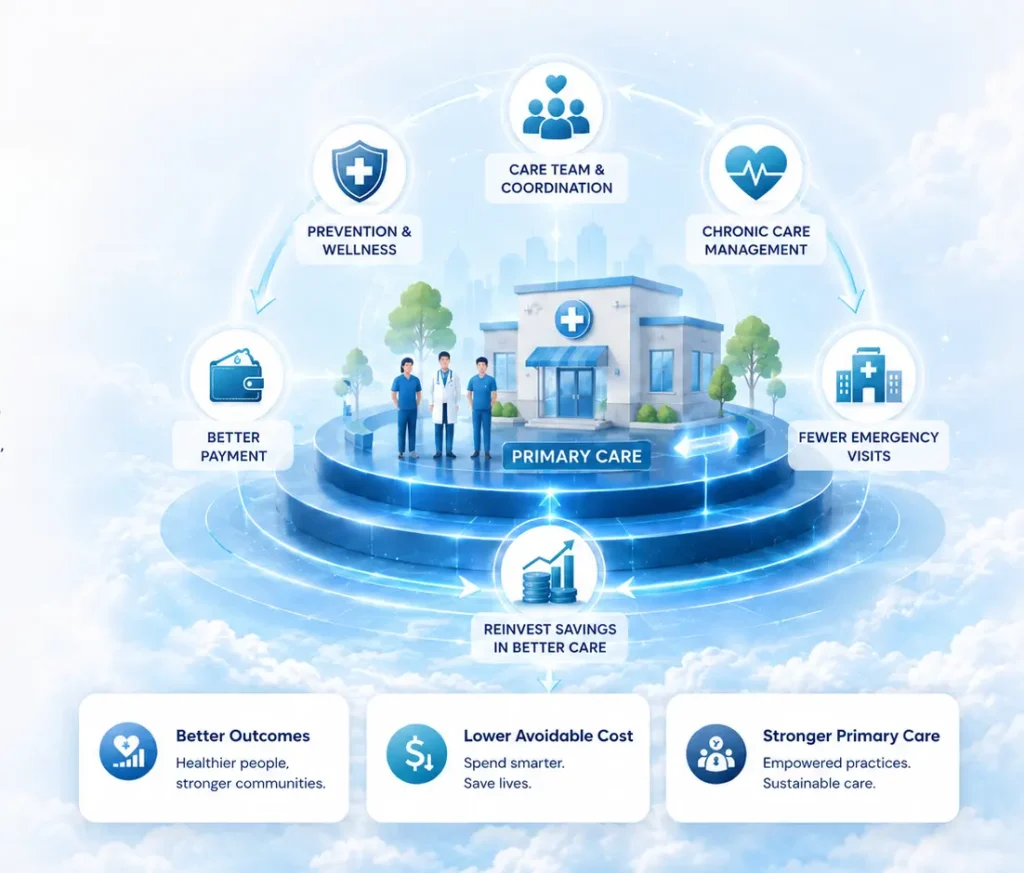
Done right, Value-Based Care gives primary care practices the financial and operational support to keep people healthier, lower avoidable costs, and reinvest savings into better care.

Better
Payment
Care Teams
+ Data
Prevention +
Chronic Care
Fewer ED
Visits
Shared
Savings
VALUE-BASED
CARE
  • 1
  • 2
  • 3
  • 4
  • 5
Better Payment

Fund prevention, care coordination, and outcomes, not just visits, procedures, and volume.

Care Teams + Data

Equip primary care teams with patient insights, risk flags, and workflows that support earlier action.

Prevention + Better Chronic Care

Help patients stay healthier by improving access, outreach, follow-up, and chronic condition management.

Fewer ED Visits + Admissions

Reduce avoidable crises by catching problems sooner and managing care before hospitalization becomes necessary.

Shared Savings Reinvestment

Reinvest savings into staffing, technology, longer visits, and stronger support for patients and practices.

“Independent primary care can’t be saved as long as someone else owns the relationship with the payer, takes a cut of every dollar, and sets the terms of the doctor’s work.

We’re not trying to be a better MSO. We’re trying to make MSOs unnecessary.”

Dr. Bhargav Raman,
Cofounder, Ten Ten Ten

Ten Ten Ten Section Preview

What we're actually building toward

Most attempts to fix value-based care assume the existing intermediary structure and try to make it kinder. We don't. The structure itself is the problem. If we do our job over a 20-year horizon, here's the end-state:

Independent practices that own their patient panels and their economics, not roll-up targets, not hospital employees.

Direct relationships with the entities actually paying for care, including employers, Medicare Advantage, and eventually CMS, with no plan or middleman skimming the spread.

Smaller panels and higher pay for primary care physicians, because they are capturing the total-cost-of-care savings they generate.

Primary care as fiduciary gatekeeper, accountable for the whole patient, the way every other professional is accountable to the people who hire them.

An open-source playbook so this is replicable, not proprietary. We want this to spread, not to corner a market.

If we succeed, primary care becomes something medical students want to do again. That's the test.

A graduated path, not a product

Practices come to us in two states: new to value-based care and intimidated by the operational lift, or late in an MSO contract and looking at renewal with dread. Either way, we start in the same place — and we move at the practice’s pace, not ours. Stop, slow down, or stay at any stage that fits.

01

ENTRY

No-risk, playbook-led

Practices join with no downside exposure while they build the muscles to manage risk.

  • VBC Contract Review Checklist
  • HCC Coding Education Toolkit V28
  • Morning Huddle Implementation Guide

02

BUILD

Infrastructure, team, confidence

Grow the things that make full risk survivable, with costs aligned to practice growth.

  • Care Team Scope of Practice Protocols

  • Integrated Behavioral Health Guide

  • Benchmarking Guidebook

03

RISK

Graduate when ready

Move into full-risk capitation when the data, team, and MLR performance say so.

  • Practice-paced timeline

  • Data, team, and MLR readiness

  • Shared savings can remain the right fit

04

DIRECT

Replace what the plan was doing

Once operating well at full risk, route around the payer where possible.

  • Direct-to-CMS for Medicare

  • Direct-to-employer for commercial

  • Practice holds the contract, Ten Ten Ten consults

05

SOVEREIGN

Primary care as fiduciary

The end-state: smaller panels, more time per patient, higher comp, real medicine.

  • Smaller panels

  • More time per patient

  • A job medical students would choose

Ten Ten Ten Stakes Section

What’s at stake

A typical 7,500-life Medicare Advantage panel at full risk generates real medical margin. The question is who keeps it. Under a standard MSO contract, up to half disappears every year, forever. Under our model, the practice keeps it.

$750K to 5M
Year 1 medical margin on a 7,500-life MA panel, depending on risk level
$1.5M to 15M
Year 3 medical margin, depending on risk level, as the panel matures
$0
What we take from that margin

Figures from our open-source full-risk financial model. Practice-specific results vary; verify county benchmark and RAF before negotiating any contract.

Ten Ten Ten Open Source Section

Why we open-source the work

We don't want to be the only people doing this. If another nonprofit, a state Medicaid program, an academic medical center, or a competing MSO with a sudden conscience wants to use our work to help practices, good. The mission is to fix primary care, not to corner a market in fixing it.

Free & Public

  • All operational playbooks
  • All financial models
  • All findings, methodology, and benchmarking data
  • The codebase that powers our analytics platform

Cost-Plus Pricing

  • Fiduciary consulting: hands-on application of the playbooks to your situation
  • Backend analytics infrastructure: managed service built on the open-source code

Certified Vendor Ecosystem

  • Access to vetted partners aligned with outcomes, cost, equity, and access
  • Less vendor noise for practices trying to build real VBC capability
  • A clearer path for responsible companies to support independent primary care
The cost-plus pieces sustain the organization. They're priced to cover real costs plus a modest margin to fund the open-source work, not to extract value the practice created.

    Primary contact

    Practice

    What happens next

    A human at Ten Ten Ten reads what you sent. Usually within a business day, you’ll get a real reply, not a calendar link, not a form letter. If we think we can help, we’ll say so. If we don’t, we’ll tell you that too, and try to point you somewhere useful.

    ×